
Every few decades, a technological shift fundamentally alters the “barrier to entry” for human knowledge. The calculator didn’t kill mathematics, but it changed how we teach it. The internet didn’t kill research, but it killed the encyclopedia. Today, we are facing a shift far more profound and, if left unaddressed, far more dangerous.
Generative AI is not just changing how we write code; it is changing how we learn to think. In the present time we see the “Junior Developer Crisis of 2026″ unfolding in real-time. It is a crisis of logic, a crisis of debugging and ultimately, a crisis of professional survival.
1. The Hook: AI Is Creating Developers Who Can’t Debug on their Own
The promise of 2026 was supposed to be the “10x Junior.” With GitHub Copilot, Cursor and ChatGPT, a student who barely knows syntax can scaffold a full-stack REST API in ninety seconds. On the surface, productivity is at an all-time high. But underneath, the foundation is rotting.
We are entering an era of “Vibe Coding.” Junior developers can now “vibe” their way through a project by describing what they want and watching the code appear. This is amazing—until something breaks.
The uncomfortable truth is that many “AI-Native” developers don’t actually understand the code they are shipping. When the AI generates a subtle logic error or a race condition, these developers don’t have the “mental stack trace” required to find it. They can’t debug because they never learned the struggle of building.
The Hard Truth: AI didn’t replace learning. It replaced the struggle. And struggle is the only place where true engineering intuition is born.
2. The Great Divide: AI-Augmented vs. AI-Dependent
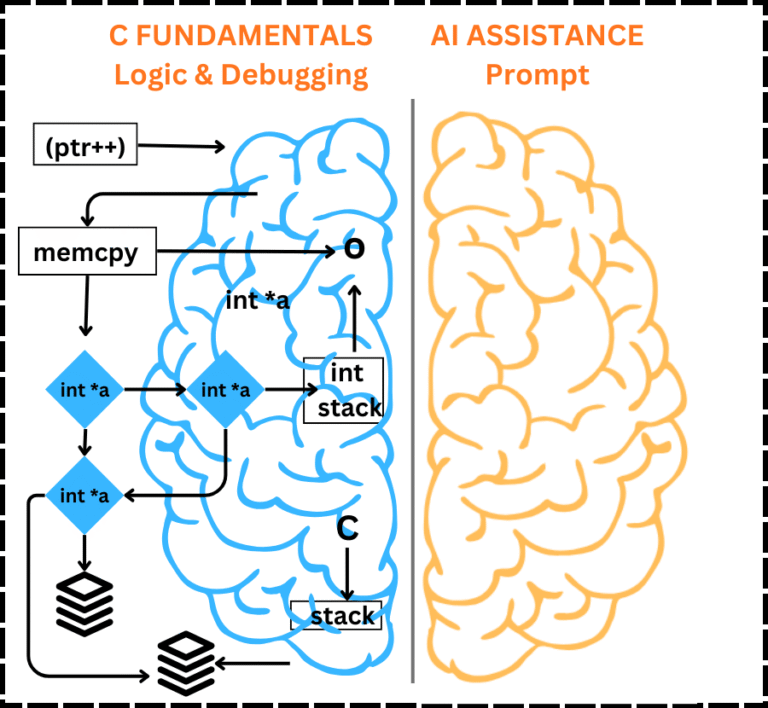
In the current landscape, two distinct classes of developers are emerging:
- The AI-Augmented Learner (The Future Senior)
These students treat AI as a high-speed mentor. They use it to explain a complex O(n log n) algorithm or to find the documentation for an obscure library. Crucially, they still write the core logic themselves. They use AI to audit their work, not to author it. If an AI suggests a fix, they ask, “Why does this work?” before they paste it.
- The AI-Dependent Coder (The Disposable Junior)
These are the students who use AI as a shortcut machine. They treat the prompt box like a “Solve My Homework” button. They don’t check for edge cases; they just check if the code compiles. In the 2026 job market, these developers are becoming invisible. Why hire a human who can only prompt an AI when the company can just buy a more expensive API key and skip the middleman?
3. The Myth of “Prompt Engineering.”
If you spent 2024 and 2025 worrying about your “Prompt Engineering” skills, I have bad news: Prompt Engineering is a temporary skill gap.
Just as we no longer need “Google Search Specialists” who know secret operators like site: and filetype:, AI models are evolving to understand natural intent. By 2027, “Prompting” will just be “Talking.” It will be a baseline literacy, not a specialized career path.
The real skill isn’t knowing how to talk to the machine; it’s knowing what to ask for. And you only know what to ask for if you understand the underlying architecture.
4. Why C and C++ Are More Important Than Ever
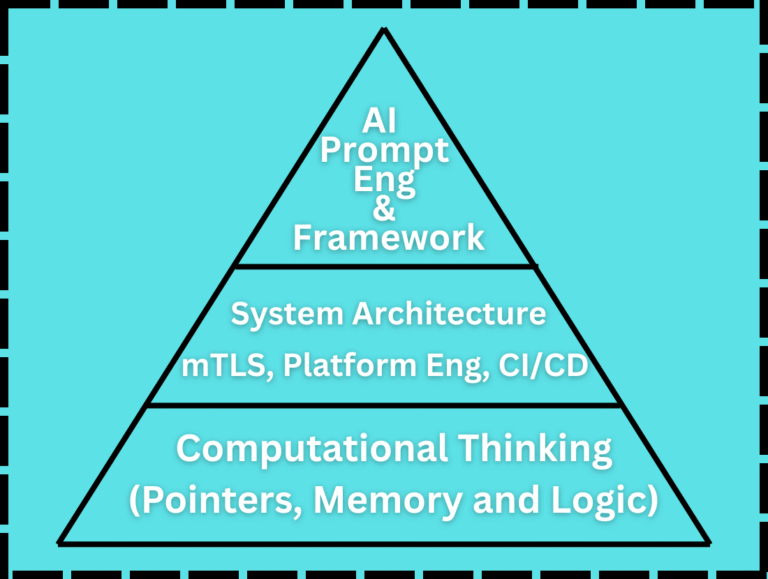
In an age of high-level abstraction, the “low-level” has become the ultimate competitive advantage. We always emphasize that while frameworks come and go, Computational Thinking is forever. This is why languages like C and C++ are the “Truth Serums” of the 2026 era.
In C, there is nowhere to hide. You cannot hide behind a garbage collector or a high-level framework. You have to understand:
- Memory Management: Why did I get a Segment Fault?
- Pointers: Where is this data actually living?
- Control Flow: How is the CPU actually executing these instructions?
When you learn C, you aren’t just learning a language; you are learning how a computer “thinks.” This foundational logic is what allows a developer to debug a complex distributed system, even when the code is in Python or Go. If you can debug a memory leak in C++, you can debug anything.
5. Debugging: The Only “AI-Proof” Superpower
Writing code is actually the easiest part of software engineering. The real job; the part that commands the high salaries, is fixing broken systems.
Debugging is a form of scientific inquiry. It requires pattern recognition, patience and a deep understanding of the state. AI can suggest a patch, but it cannot yet perform the high-level reasoning required to understand why a system failed at 3:00 AM under a specific load.
Senior developers are increasingly becoming “Code Auditors.” Their value lies in their ability to look at 500 lines of AI-generated code and say, “Wait, this will cause a deadlock under high concurrency.” A developer who can’t debug is just a typist. A developer who can debug is an architect.
6. What Companies Are Actually Hiring For in 2026
The data from the 2026 job market is clear: the “Junior Gap” is real. Companies are hiring fewer entry-level roles, and the roles they do hire for have a much higher skill bar.
The “Vibe Coder” is unemployable. Companies want engineers who can:
- Explain the Code: If you can’t walk through a pull request and explain every design decision, you don’t own that code.
- Trace Logic Errors: Can you find the bug when the AI says everything is “fine”?
- Design for Scale: AI is great at snippets but it is often terrible at long-term system maintainability.
7. The 2026 Developer Formula
To survive the Junior Dev Crisis, you must adopt a new formula for your career:
(Computational Thinking * Logic Fundamentals) + AI Assistance = 10x Productivity
If you remove the “Computational Thinking” or the “Logic” you are left with a 0.5x developer who is entirely dependent on a subscription service to do their job.
How to use AI the “Right Way”:
- Use AI to explain concepts, not to write them. If you see a piece of syntax you don’t know, ask: “Explain the underlying logic of this line.“
- Review AI-generated code as if it were written by a rival. Be critical. Look for the flaws. Assume it is wrong until you prove it is right.
- Go back to the basics. Spend one hour a week writing code in a plain text editor without Copilot. Keep those “logical muscles” strong.
Final Thought: The Engine vs. The Steering Wheel
AI is the most powerful engine ever put into the hands of a developer. But an engine without a steering wheel is just a fast way to hit a wall.
Logic and Debugging are your steering wheel. As we move deeper into this AI era, the developers who thrive won’t be the ones who can prompt the fastest. They will be the ones who can say: “AI wrote the code, but I understand the system“. Because when the system breaks, someone needs to be the adult in the room who can fix it. Don’t be an operator. Be an engineer.